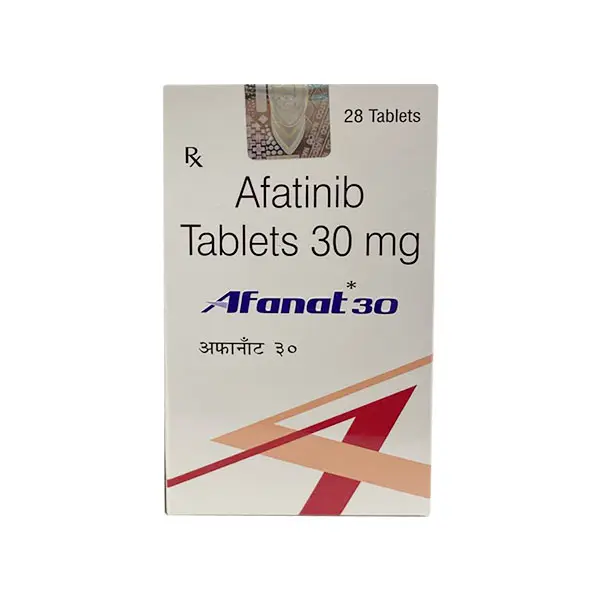
What Is Afatinib 30 mg?
Afatinib 30 mg tablet is an oral targeted anticancer medicine belonging to the tyrosine kinase inhibitor class.
It is primarily used in selected patients with advanced or metastatic non-small cell lung cancer (NSCLC), particularly when the tumor contains susceptible mutations in the epidermal growth factor receptor (EGFR) gene.
EGFR is a protein found on the surface of many cells. It helps regulate cell growth, division and survival.
Certain mutations in the EGFR gene can cause abnormal receptor activity, allowing cancer cells to grow and multiply uncontrollably.
Afatinib works by irreversibly inhibiting several receptors belonging to the ErbB family, including EGFR (ErbB1), HER2 (ErbB2) and ErbB4.
How Does Afatinib 30 mg tablet Work?
However, EGFR signaling is also important in normal tissues, especially the skin and gastrointestinal tract.
Consequently, diarrhea, skin rash, mouth inflammation and nail changes are common adverse effects.
Afatinib 30 mg tablet may be prescribed as part of an individualized treatment plan when a lower dose is necessary to improve tolerability.
1. Targets the ErbB Receptor Family
Afatinib inhibits several receptor tyrosine kinases belonging to the ErbB family.
These receptors participate in cellular growth and survival signaling.
2. Inhibits EGFR Activity
Certain EGFR mutations produce abnormal signaling that promotes cancer cell growth.
Afatinib blocks the kinase activity of susceptible EGFR receptors.
3. Forms an Irreversible Bond
Afatinib forms covalent bonds with the kinase domains of targeted receptors.
This produces irreversible inhibition of receptor activity.
4. Suppresses Growth-Promoting Signals
Afatinib reduces signaling through pathways involved in cell proliferation and survival.
5. Interferes With Cancer Cell Division
By inhibiting abnormal receptor signaling, afatinib can slow the multiplication of susceptible cancer cells.
6. Promotes Cancer Cell Death
In certain EGFR-dependent tumors, inhibition of signaling may promote apoptosis.
7. Helps Control Tumor Growth
Afatinib may reduce tumor size or delay disease progression in appropriately selected patients.
8. Provides Molecularly Targeted Therapy
Its clinical activity depends significantly on the tumor’s molecular characteristics.
Important: Not all EGFR mutations respond equally to afatinib. Resistance mutations, including EGFR T790M, may reduce treatment effectiveness.
Uses of Afatinib 30 mg
1. EGFR Mutation-Positive Non-Small Cell Lung Cancer
Afatinib is used to treat selected patients with advanced or metastatic NSCLC containing susceptible EGFR mutations.
Treatment selection depends on molecular testing and current oncology guidelines.
2. EGFR Exon 19 Deletion-Positive NSCLC
Afatinib has established activity against certain EGFR exon 19 deletion mutations.
However, newer targeted therapies may be preferred in many current treatment settings.
3. EGFR L858R Mutation-Positive NSCLC
Afatinib may be used in selected patients whose tumors contain the EGFR exon 21 L858R mutation.
4. Selected Uncommon EGFR Mutations
Afatinib has demonstrated activity against certain uncommon EGFR mutations, including:
- G719X
- L861Q
- S768I
Its suitability depends on the specific mutation, previous treatment and applicable regulatory approval.
5. Advanced Non-Small Cell Lung Cancer
Afatinib may be prescribed for locally advanced or metastatic disease when the tumor’s molecular characteristics support its use.
6. Metastatic NSCLC
In eligible patients, afatinib may help control cancer growth and delay disease progression.
7. Previously Treated Squamous NSCLC
Afatinib has an approved indication in certain jurisdictions for metastatic squamous NSCLC that progresses after platinum-based chemotherapy.
Its current clinical role depends on available alternatives and oncology guidelines.
8. Dose-Adjusted EGFR-Targeted Therapy
The 30 mg strength is commonly used when the initial 40 mg dose causes adverse effects requiring dose reduction.
9. Individualized Oncology Treatment
Afatinib may be selected based on mutation status, previous treatments, patient health and expected tolerability.
10. Long-Term Disease Control
When effective and tolerated, afatinib may be continued to help control cancer progression.
Important: Afatinib should not be advertised as a universal treatment for lung cancer or as effective against every EGFR mutation.
How to Take Afatinib 30 mg
Afatinib must be taken strictly according to the oncology specialist’s prescription.
General Administration Instructions
- Confirm the prescribed tablet strength and treatment schedule.
- Take afatinib at approximately the same time each day.
- Take the medicine on an empty stomach.
- Avoid food for at least 3 hours before and 1 hour after administration.
- Swallow the tablet whole with water.
- Do not independently increase or decrease the dose.
- Do not take extra tablets to compensate for a missed dose.
- Report persistent diarrhea, severe skin reactions or breathing difficulties promptly.
- Attend scheduled oncology appointments and laboratory tests.
- Follow any prescribed treatment interruption or dose-reduction plan.
Is Afatinib 30 mg a Standard Starting Dose?
For many approved adult NSCLC regimens, 40 mg once daily is the usual starting dose.
The 30 mg strength is commonly used after dose reduction because of adverse reactions.
In selected circumstances, an oncologist may prescribe 30 mg as an individualized starting dose.
Should Afatinib Be Taken With Food?
No. Afatinib should generally be taken on an empty stomach because food can reduce drug exposure.
Can Afatinib 30 mg Be Taken Once Daily?
Yes. Afatinib is generally prescribed once daily.
The exact dose and schedule must follow the oncology prescription.
Can Afatinib Be Taken at Night?
Afatinib may be taken at a consistent time that accommodates the required fasting interval.
Can Afatinib Tablets Be Crushed?
Afatinib tablets should generally be swallowed whole.
For patients who cannot swallow tablets, certain product instructions describe dispersion in noncarbonated water.
Alternative administration methods should only be used according to the specific manufacturer’s instructions and oncology guidance.
What If a Dose Is Missed?
Under standard afatinib labeling, a missed dose may be taken when remembered unless the next scheduled dose is within 12 hours.
If the next dose is within 12 hours, skip the missed dose.
Do not double the dose.
What If Too Much Afatinib Is Taken?
An overdose may cause serious gastrointestinal, skin and other toxicities.
Seek urgent medical attention.
How Long Does Afatinib 30 mg Take to Work?
The response to afatinib depends on the tumor’s EGFR mutation, disease characteristics and individual treatment response.
After Administration
Afatinib is absorbed and begins inhibiting susceptible ErbB receptor signaling.
During the First Several Weeks
Biological effects on susceptible cancer cells may occur.
During Early Treatment Assessment
Imaging studies may demonstrate tumor shrinkage or disease stabilization.
During Continued Treatment
The oncology team evaluates treatment effectiveness, adverse reactions and possible disease progression.
Important: Afatinib effectiveness should be assessed through clinical evaluation and imaging rather than symptoms alone.
Common Side Effects
Possible side effects include:
- Diarrhea
- Acne-like skin rash
- Dry skin
- Itching
- Mouth sores
- Stomatitis
- Nausea
- Vomiting
- Reduced appetite
- Weight loss
- Nail inflammation
- Paronychia
- Fatigue
- Nosebleeds
- Eye irritation
- Elevated liver enzymes
Diarrhea and skin reactions are particularly important because they may become severe and require medical treatment, dose interruption or dose reduction.
Serious Side Effects
Seek urgent medical attention if any of the following occur:
- Severe or persistent diarrhea
- Signs of dehydration
- Significant reduction in urine output
- New or worsening shortness of breath
- Persistent cough with fever
- Severe blistering or peeling skin
- Severe mouth inflammation
- Yellowing of the skin or eyes
- Severe abdominal pain
- Sudden vision changes
- Severe eye pain
- Significant weakness or dizziness
Important Serious Risks
Severe Diarrhea: Afatinib can cause severe diarrhea, dehydration and electrolyte disturbances.
Dehydration and Kidney Injury: Persistent diarrhea may lead to dehydration and acute kidney injury.
Interstitial Lung Disease: Rare but potentially fatal interstitial lung disease or pneumonitis may occur.
Severe Skin Reactions: Serious dermatological reactions, including blistering and exfoliative skin conditions, have been reported.
Hepatotoxicity: Afatinib may cause serious liver injury, including rare fatal cases.
Keratitis: Corneal inflammation and other eye complications may occur.
Cardiac Dysfunction: Afatinib may affect left ventricular function in some patients.
Embryo-Fetal Toxicity: Afatinib can harm a developing fetus.
Contraindications & Precautions
1. Allergy to Afatinib
Patients with known serious hypersensitivity to afatinib or formulation ingredients should not use the medicine.
2. EGFR Mutation Testing
Molecular testing is important when selecting afatinib for EGFR mutation-directed NSCLC treatment.
3. Severe Diarrhea
Persistent or severe diarrhea requires prompt medical management.
4. Dehydration
Patients experiencing diarrhea or vomiting are at risk of dehydration and electrolyte abnormalities.
5. Kidney Disease
Patients with kidney impairment require careful evaluation. Dose adjustment may be necessary in severe renal impairment.
6. Liver Disease
Patients with liver impairment require monitoring for potential hepatotoxicity.
7. Interstitial Lung Disease
New or worsening respiratory symptoms require immediate medical assessment.
8. Severe Skin Reactions
Severe rash, blistering or peeling skin requires prompt evaluation.
9. Eye Disorders
Patients with eye pain, redness, light sensitivity or vision changes should seek medical attention.
10. Heart Disease
Patients with cardiac risk factors may require additional assessment and monitoring.
11. Pregnancy
Afatinib can cause fetal harm and should generally be avoided during pregnancy.
12. Breastfeeding
Breastfeeding is not recommended during treatment and for the period specified in the product labeling after the final dose.
13. Fertility
Reproductive planning and fertility considerations should be discussed before treatment.
14. Drug Interactions
Potential interactions include medicines affecting P-glycoprotein (P-gp), such as:
- Rifampicin
- Ritonavir
- Cyclosporine
- Certain P-gp inhibitors
- Certain P-gp inducers
Interaction management may require changes in administration timing, dose or treatment selection.
15. Food Interactions
Food reduces afatinib exposure.
The recommended fasting interval should be followed.
16. Medication Adherence
Consistent dosing is important for maintaining appropriate treatment exposure.
17. Dose Reduction
Significant adverse reactions may require treatment interruption or further dose reduction.
18. Medical Monitoring
Healthcare professionals may assess:
- EGFR mutation status
- Cancer stage
- Treatment response
- Imaging findings
- Diarrhea severity
- Hydration status
- Kidney function
- Liver function
- Electrolyte levels
- Skin reactions
- Nail changes
- Oral mucositis
- Eye symptoms
- Respiratory symptoms
- Cardiac function when indicated
- Weight changes
- Nutritional status
- Medication interactions
- Need for dose interruption
- Need for further dose reduction
- Disease progression
Potential Therapeutic Advantages
- Targeted Anticancer Activity.
- EGFR Tyrosine Kinase Inhibition.
- Irreversible ErbB Receptor Inhibition.
- Oral Tablet Formulation.
- Once-Daily Administration.
- 30 mg Dose-Reduction Strength.
- Selected EGFR Mutation-Positive NSCLC Treatment.
- Activity Against Certain Uncommon EGFR Mutations.
- Molecularly Guided Treatment Selection.
- Cancer Growth Signaling Inhibition.
- Potential Tumor Growth Control.
- Individualized Dose Adjustment.
- Specialist-Directed Long-Term Treatment.
Disadvantages / Limitations
- Not Suitable for Every Lung Cancer.
- Requires Molecular Testing.
- May Cause Severe Diarrhea.
- May Cause Dehydration.
- May Cause Skin Rash.
- May Cause Mouth Sores.
- May Cause Nail Inflammation.
- May Cause Reduced Appetite.
- May Cause Weight Loss.
- May Cause Liver Injury.
- May Cause Kidney Complications.
- Rare Interstitial Lung Disease Risk.
- Potential Eye Complications.
- Potential Cardiac Effects.
- Pregnancy-Related Harm.
- Requires Empty-Stomach Administration.
- Potential Drug Interactions.
- May Require Further Dose Reduction.
- Requires Regular Oncology Monitoring.
- Cancer May Develop Treatment Resistance.
- Does Not Guarantee a Cure.
Important Notes
Generic Name: Afatinib.
Strength: 30 mg.
Drug Class: Tyrosine Kinase Inhibitor.
Therapeutic Category: Targeted Anticancer Medicine.
Mechanism of Action: Irreversible ErbB Receptor Tyrosine Kinase Inhibition.
Primary Indication: Selected EGFR Mutation-Positive NSCLC.
Route: Oral.
Typical Administration: Once Daily.
30 mg Strength: Commonly Used for Dose Reduction.
Food Requirement: Empty Stomach.
Major Warning: Severe Diarrhea and Dehydration.
Lung Warning: Interstitial Lung Disease Risk.
Liver Monitoring: Important.
Kidney Monitoring: As Clinically Indicated.
Pregnancy: Can Cause Fetal Harm.
Breastfeeding: Not Recommended During Treatment.
Medical Supervision: Oncology Specialist Required.
Storage: Follow Manufacturer Instructions.
Frequently Asked Questions
1. What is Afatinib 30 mg used for?
Afatinib is used to treat selected forms of advanced or metastatic non-small cell lung cancer, particularly tumors containing susceptible EGFR mutations.
2. Is Afatinib 30 mg a chemotherapy medicine?
Afatinib is a targeted anticancer medicine classified as a tyrosine kinase inhibitor. It differs from conventional cytotoxic chemotherapy.
3. How does Afatinib work?
It irreversibly inhibits certain ErbB receptor tyrosine kinases, including EGFR, and interferes with cancer growth signaling.
4. Is Afatinib 30 mg used for lung cancer?
Yes. Afatinib is used in selected NSCLC patients when the tumor’s molecular characteristics and treatment history support its use.
5. Does Afatinib require EGFR testing?
EGFR mutation testing is important when selecting afatinib for mutation-directed NSCLC treatment.
6. Is Afatinib 30 mg a standard starting dose?
For many approved adult NSCLC regimens, 40 mg once daily is the usual starting dose. The 30 mg strength is commonly used after dose reduction.
7. Can Afatinib 30 mg be taken daily?
Yes. Afatinib is generally administered once daily according to the oncology prescription.