
















Drug policy: generic medicines explained
PharmEasyBank supplies generic medicines. Here’s what a generic is and why it costs less than the brand-name original.
- A generic must contain the same active ingredients as the brand-name medicine.
- It is bioequivalent to the brand, so its maker doesn't repeat the original clinical trials.
- Generic makers skip the brand's research, development and advertising costs.
- Competition from generics brings prices down.
- The savings help patients and insurance companies alike.
What we supply
Generic medicines only
We don't carry brand-name products. See our terms.
Same active ingredients
A generic must contain the same active ingredients as the original brand.
Personal use only
Our medicines aren't for resale or commercial import. See our disclaimer.
Your provider first
Tell your healthcare provider you're using a generic, so they prescribe the right medicine and dose.
Generics explained
What a generic drug is.
What is a generic drug?
A generic drug, often just called a “generic”, is a medicine made and sold without patent protection on its active ingredient. The brand may still hold a patent on its particular formulation, but not on the active ingredient itself.
A generic has to contain the same active ingredients as the original brand-name medicine.
What does "bioequivalent" mean here?
Generic drugs are bioequivalents of the brand-name drugs they copy. The brand-name company has already run the clinical trials that showed the medicine is safe and effective, so the generic maker doesn’t have to prove that again.
Why generics cost less
Where the brand-name price comes from, and the costs a generic maker avoids.
No research and development bill
Creating a new brand-name medicine can cost hundreds of millions to billions of dollars and usually takes 10 to 15 years. The brand company has to earn that money back, which is why patented medicines cost much more.
A generic maker doesn’t need a new formula or new production technology. It works from what is already known about the drug and reverse-engineers the existing compound.
No repeat clinical trials
The original company has already proved the drug’s safety and efficacy in clinical trials. Generic manufacturers don’t carry that cost.
Less advertising
Brand-name medicines need large advertising and marketing campaigns to build awareness and a brand identity, and that adds to their price. Generics benefit from the marketing the brand has already done, such as media adverts, visits from drug representatives and free samples, so they don’t need the same spend.
Competition
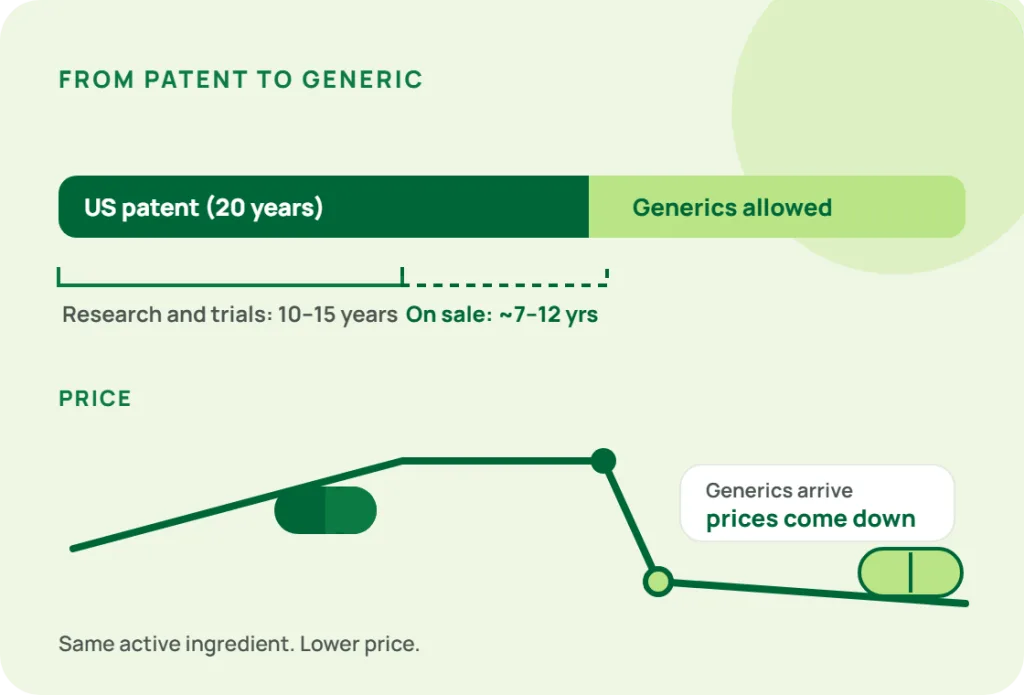
When generic versions reach the market, they compete with the original. That competition often lowers prices, for the generics and for the brand-name product too.
Patents and timing
Why a generic can take years to appear.
How long patents last
In the United States, a drug patent gives 20 years of protection. Companies usually file the patent before clinical trials begin, so the medicine is typically on sale with patent protection for only about 7 to 12 years.
What a new drug costs to develop
Estimates of what it costs a brand-name company to discover and test a new drug with a new chemical entity go as high as $800 million. Other estimates are lower: Merrill Goozner, in his book The $800 Million Pill, suggests $100–200 million.
"Evergreening"
Brand-name companies sometimes try to keep their exclusive position and hold off generic competition, including through legal action to keep or extend a patent. Critics call this “evergreening”.
The first patent on a new compound is usually granted early in development, which starts the countdown to expiry. Later, a company may apply for further patents on particular forms of the compound, such as single enantiomers, different inactive components in a drug salt, or specific hydrate forms. If granted, these can reset the expiry clock, but generic manufacturers may challenge them.
What this means for you
Why we focus on generics.
Effective treatment at a lower cost
Generic drugs save money for patients and for insurance companies. At PharmEasyBank we offer a wide range of quality generics, so you can get effective treatment while keeping your healthcare costs down. Affordable medicine shouldn’t mean compromising on your health.
Questions about a medicine?
Ask us before you order. If you’re moving from a brand-name medicine to a generic, check with your healthcare provider too.