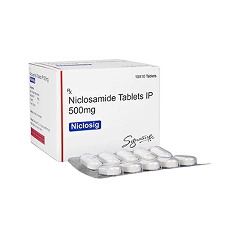
What Is Niclosamide 500 mg?
Niclosamide 500 mg is an anthelmintic medicine containing 500 mg of niclosamide, an antiparasitic agent used to treat certain infections caused by intestinal tapeworms.
Niclosamide belongs to the salicylanilide class of compounds and acts primarily within the gastrointestinal tract.
It has been used in the treatment of intestinal cestode infections, including infections caused by certain species of Taenia, Diphyllobothrium (now classified in part under Dibothriocephalus) and Hymenolepis.
Tapeworms are parasitic flatworms that can inhabit the human intestine and absorb nutrients from their surroundings.
Niclosamide works by disrupting the parasite’s energy metabolism, impairing its ability to survive.
The medicine is poorly absorbed from the gastrointestinal tract, which helps concentrate its action within the intestinal lumen.
How Does Niclosamide 500 mg Work?
1. Acts Within the Intestinal Tract
Niclosamide is poorly absorbed into the bloodstream after oral administration.
Its primary antiparasitic action occurs in the intestinal lumen.
2. Targets Tapeworm Energy Metabolism
Niclosamide interferes with metabolic processes required for parasite survival.
3. Disrupts Oxidative Phosphorylation
Niclosamide can uncouple oxidative phosphorylation, interfering with the production of usable cellular energy.
4. Reduces ATP Production
By disrupting energy metabolism, niclosamide reduces the parasite’s ability to generate sufficient adenosine triphosphate (ATP).
5. Impairs Parasite Survival
Energy depletion interferes with essential biological processes required for the tapeworm to remain viable.
6. Acts Against Susceptible Intestinal Cestodes
Niclosamide is active against certain intestinal tapeworm species.
Its effectiveness depends on the parasite involved.
7. Facilitates Parasite Elimination
After the parasite is killed, its remains may be digested or passed through the intestinal tract.
8. Provides Localized Antiparasitic Treatment
Because systemic absorption is limited, niclosamide is mainly useful for susceptible parasites within the intestine rather than parasites in organs or tissues.
Uses of Niclosamide 500 mg
1. Intestinal Tapeworm Infection
Niclosamide is used to treat selected intestinal infections caused by tapeworms.
Treatment should be based on appropriate clinical diagnosis.
2. Beef Tapeworm Infection
Niclosamide may be used for intestinal infection caused by Taenia saginata, the beef tapeworm.
3. Pork Tapeworm Infection
Niclosamide has activity against adult intestinal Taenia solium tapeworms.
However, infection with T. solium requires special clinical consideration because its eggs can cause cysticercosis.
Treatment selection should follow current guidelines, particularly when neurocysticercosis is possible.
4. Fish Tapeworm Infection
Niclosamide has been used to treat certain fish tapeworm infections, including infections historically described as Diphyllobothrium latum.
5. Dwarf Tapeworm Infection
Niclosamide may be used for Hymenolepis nana infection.
This infection may require a longer or different treatment schedule than other tapeworm infections.
6. Selected Other Intestinal Cestode Infections
Niclosamide may be effective against other susceptible intestinal cestodes, depending on the species and clinical guidance.
7. Intestinal Parasite Management
Niclosamide can form part of a treatment plan that includes parasite identification, appropriate medicine selection and follow-up testing.
8. Prevention of Ongoing Intestinal Infection
Successful treatment may eliminate an existing susceptible intestinal tapeworm.
However, it does not provide immunity against future infections.
How to Take Niclosamide 500 mg
Niclosamide 500 mg should be used according to the instructions of a qualified healthcare professional.
General Administration Instructions
- Confirm the suspected or diagnosed parasite.
- Verify that niclosamide is appropriate for the infection.
- Check the tablet formulation.
- Follow the prescribed dose.
- Chew or crush tablets only if directed by the product labeling.
- Follow the recommended timing in relation to food.
- Do not take extra doses.
- Complete the prescribed treatment regimen.
- Maintain appropriate food and personal hygiene.
- Attend follow-up testing when recommended.
Pediatric Dosing
Children require age-appropriate dosing.
The appropriate dose should be determined by a healthcare professional.
How Should Niclosamide Tablets Be Swallowed?
Some niclosamide products are chewable tablets and should be thoroughly chewed or crushed before swallowing.
Other formulations may have different instructions.
Always verify the exact product label.
Can Niclosamide Be Taken With Food?
Administration instructions vary by product and local treatment protocol.
Some regimens recommend taking the medicine after a light meal.
Follow the product-specific instructions.
What If a Dose Is Missed?
If the prescribed regimen includes multiple doses, contact the healthcare professional or follow the product leaflet.
Do not double doses without medical advice.
Is a Laxative Required?
A laxative is not routinely required for all niclosamide treatment regimens.
A healthcare professional may recommend additional measures in selected circumstances.
How Long Does Niclosamide 500 mg Take to Work?
Niclosamide begins acting against susceptible intestinal parasites after administration.
Within the First Day
The medicine interferes with parasite energy metabolism.
Following Treatment
The affected tapeworm may be digested or eliminated through the digestive tract.
Several Days Later
Some patients may experience improvement in symptoms associated with the intestinal infection.
Follow-Up Period
A healthcare professional may recommend stool testing to confirm successful treatment.
Important: The absence of visible worms in stool does not necessarily establish that the infection has been cured.
Common Side Effects
Possible side effects include:
- Nausea
- Vomiting
- Abdominal discomfort
- Stomach pain
- Diarrhea
- Reduced appetite
- Dizziness
- Headache
- Unpleasant taste
- Mild skin irritation or itching
Most reported adverse effects are gastrointestinal and may be temporary.
Serious Side Effects
Serious adverse reactions are uncommon but may occur.
Seek medical attention for:
- Severe allergic reactions
- Difficulty breathing
- Swelling of the face, lips, tongue or throat
- Severe or persistent vomiting
- Significant dehydration
- Severe abdominal pain
- Persistent or worsening symptoms
Important Safety Risks
Allergic Reactions: Hypersensitivity reactions may occur in susceptible individuals.
Incorrect Parasite Diagnosis: Using niclosamide for an infection it does not treat can delay effective care.
Tissue Parasite Infections: Niclosamide is not suitable for treating neurocysticercosis or other systemic larval infections.
Contraindications & Precautions
1. Allergy to Niclosamide
Patients with known hypersensitivity to niclosamide or formulation ingredients should avoid the medicine.
2. Confirmed Parasite Diagnosis
Treatment should ideally be based on parasite identification or a clinically appropriate diagnosis.
3. Neurocysticercosis
Niclosamide is not an appropriate treatment for neurocysticercosis.
4. Tissue-Based Parasitic Infections
Because systemic absorption is limited, niclosamide does not reliably treat parasites outside the intestine.
5. Pregnancy
Available human pregnancy safety data are limited.
Treatment during pregnancy requires medical assessment of benefits, risks and alternative options.
6. Breastfeeding
A healthcare professional should assess the available safety information and the need for treatment.
7. Children
Pediatric dosing must be selected according to age, weight, formulation and indication.
8. Older Adults
Older adults should receive treatment appropriate to their overall health and medication profile.
9. Liver Disease
Patients with significant liver disease should inform their healthcare professional before treatment.
10. Kidney Disease
Although niclosamide has limited systemic absorption, patients with significant kidney disease should disclose their condition.
11. Gastrointestinal Disorders
Patients with severe or persistent gastrointestinal symptoms require medical assessment.
12. Persistent Vomiting
Vomiting soon after administration may affect treatment effectiveness.
Contact the prescriber for advice rather than repeating the dose independently.
13. Reinfection Risk
Niclosamide does not prevent reinfection.
Appropriate food hygiene and sanitation remain important.
14. Food Safety
Undercooked meat or fish may transmit certain tapeworm infections.
Safe food preparation can reduce the risk of infection.
15. Personal Hygiene
Handwashing and sanitation are especially important in preventing transmission of certain intestinal parasites.
16. Drug Interactions
Clinically important interactions are not well characterized for every formulation.
Patients should provide their healthcare professional with a complete list of medicines and supplements.
17. Alcohol
Patients should follow the product leaflet and prescriber’s advice regarding alcohol use during treatment.
18. Medical Monitoring
Healthcare professionals may monitor:
- Parasite species
- Symptoms
- Treatment adherence
- Gastrointestinal adverse effects
- Allergic reactions
- Stool examination results
- Evidence of persistent infection
- Reinfection risk
- Treatment response
- Need for additional antiparasitic therapy
Potential Advantages
- Established anthelmintic medicine.
- Active against certain intestinal tapeworms.
- Localized action within the gastrointestinal tract.
- Limited systemic absorption.
- Disrupts parasite energy metabolism.
- Oral administration.
- May be administered as a single dose for certain infections.
- Available in 500 mg strength.
- Useful for selected cestode infections.
- Can be included in parasite-specific treatment plans.
- May eliminate susceptible adult intestinal tapeworms.
- Established history of antiparasitic use.
Disadvantages / Limitations
- Not effective against all intestinal parasites.
- Does not reliably treat tissue-based infections.
- Not suitable for neurocysticercosis.
- May cause nausea.
- May cause vomiting.
- May cause abdominal discomfort.
- May cause diarrhea.
- May cause dizziness.
- May cause headache.
- May cause allergic reactions.
- Requires parasite-specific dosing.
- Some infections require longer treatment.
- May require follow-up stool testing.
- Does not prevent reinfection.
- Incorrect use may delay appropriate treatment.
- Pregnancy safety data are limited.
- Product availability varies by country.
- Not an established COVID-19 treatment.
- Not an approved cancer treatment.
Important Notes
Generic Name: Niclosamide.
Strength: 500 mg.
Drug Class: Anthelmintic / Antiparasitic.
Therapeutic Category: Intestinal Tapeworm Treatment.
Primary Use: Selected Intestinal Cestode Infections.
Mechanism of Action: Disruption of Parasite Energy Metabolism.
Route: Oral.
Absorption: Limited Systemic Absorption.
Common Adult Regimen: 2 g as a single dose for certain tapeworm infections, subject to clinical guidance.
Important Limitation: Not Effective for Neurocysticercosis.
Pregnancy: Medical Assessment Required.
Follow-Up: Stool Testing May Be Recommended.
Prescription Status: Depends on Local Regulations.
Storage: Follow Manufacturer Instructions.
Frequently Asked Questions
1. What is Niclosamide 500 mg used for?
Niclosamide 500 mg is an antiparasitic medicine used to treat certain intestinal tapeworm infections.
2. What is the active ingredient in Niclosamide 500 mg?
The active ingredient is niclosamide 500 mg.
3. Is niclosamide an antiparasitic medicine?
Yes. Niclosamide is an anthelmintic medicine that acts against certain intestinal cestodes.
4. How does niclosamide work?
Niclosamide disrupts parasite energy metabolism, interfering with the tapeworm’s ability to survive.
5. Can niclosamide treat tapeworm infections?
Yes. Niclosamide can treat selected intestinal tapeworm infections when the parasite is susceptible.
6. Can niclosamide treat beef tapeworm infection?
Niclosamide has been used to treat intestinal infection caused by Taenia saginata.
7. Can niclosamide treat pork tapeworm infection?
It has activity against adult intestinal Taenia solium, but treatment requires appropriate medical assessment because of the risk of cysticercosis.
8. Can niclosamide treat fish tapeworm infection?
Yes. Niclosamide has been used against certain intestinal fish tapeworm infections.