






























































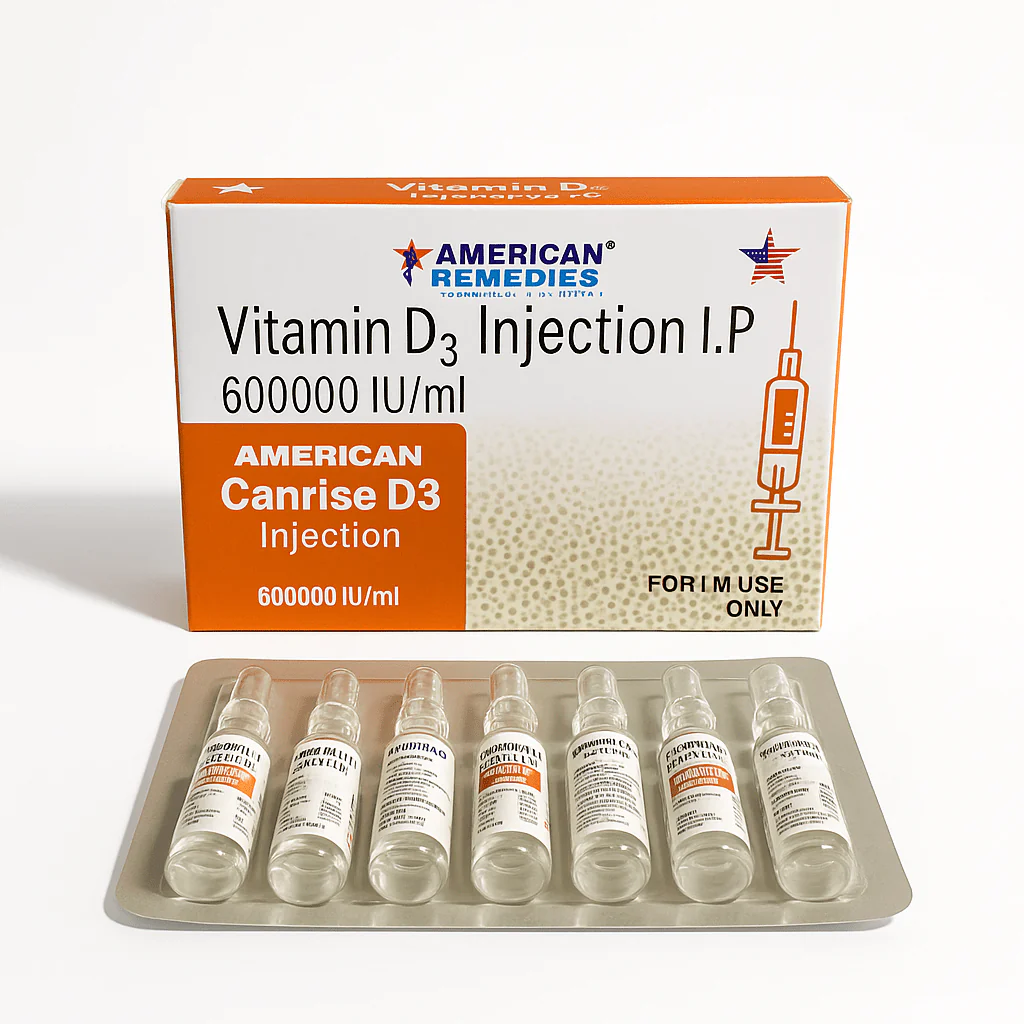
What Is Vitamin D3 Injection 60K IU?
Vitamin D3 Injection 60K IU is a high-strength injectable preparation containing cholecalciferol, commonly known as vitamin D3.
Vitamin D3 is a fat-soluble vitamin essential for maintaining normal calcium and phosphorus metabolism, supporting bone mineralization, and contributing to healthy muscle function.
Vitamin D helps the body absorb calcium and phosphorus from the digestive system. These minerals play important roles in maintaining bone strength, normal muscle contraction, and several other physiological processes.
Vitamin D deficiency may develop because of inadequate sunlight exposure, insufficient dietary intake, gastrointestinal malabsorption, certain medications, or underlying medical conditions.
Vitamin D3 Injection 60K IU may be considered when vitamin D replacement is medically necessary and an injectable formulation is appropriate.
Injectable vitamin D bypasses gastrointestinal absorption, which may be useful in selected patients with significant malabsorption or other medical indications.
How Does Vitamin D3 Injection 60K IU Work?
1. Supports Calcium Absorption
Vitamin D plays a central role in regulating calcium absorption and metabolism.
After administration, cholecalciferol undergoes metabolic conversion into active vitamin D compounds.
These compounds help maintain calcium balance and support normal bone mineralization.
2. Supports Phosphorus Metabolism
Vitamin D contributes to phosphorus absorption and regulation.
Calcium and phosphorus work together to maintain healthy bone structure and normal cellular functions.
3. Supports Bone Mineralization
Vitamin D is essential for normal bone mineralization.
Deficiency may interfere with the body’s ability to maintain properly mineralized bones.
Correcting deficiency helps restore the conditions required for normal bone health.
4. Supports Normal Muscle Function
Vitamin D contributes to normal muscle function.
Severe deficiency can cause muscle weakness or discomfort.
Appropriate replacement may improve symptoms caused by vitamin D deficiency.
5. Supports Normal Immune Function
Vitamin D participates in immune system regulation.
However, high-dose vitamin D injections have not been established as a reliable treatment or preventive measure for infections or immune disorders.
6. Restores Vitamin D Levels
After administration, cholecalciferol is converted in the liver to 25-hydroxyvitamin D.
Further activation occurs primarily in the kidneys.
The active form of vitamin D helps regulate calcium and phosphorus metabolism.
Uses of Vitamin D3 Injection 60K IU
1. Vitamin D Deficiency
May be prescribed to correct vitamin D deficiency when injectable replacement is clinically appropriate.
2. Vitamin D Malabsorption
May be considered for selected patients with gastrointestinal conditions that interfere with normal vitamin D absorption.
3. Osteomalacia
Vitamin D replacement is an important component of treatment for osteomalacia caused by vitamin D deficiency.
Osteomalacia is characterized by inadequate mineralization of adult bones.
4. Bone Health Support
Vitamin D is necessary for normal calcium absorption and bone mineralization.
Correcting deficiency helps support healthy bone metabolism.
5. Deficiency-Related Muscle Weakness
Vitamin D replacement may improve muscle weakness associated with vitamin D deficiency.
6. Osteoporosis Management
Vitamin D replacement may be included in osteoporosis management when vitamin D levels are inadequate.
It does not replace other indicated osteoporosis treatments.
7. Nutritional Deficiency Management
May be considered when vitamin D deficiency has been identified and injectable replacement is appropriate.
8. Selected Patients Unable to Use Oral Supplements
Injectable vitamin D may be considered when oral supplementation is unsuitable or ineffective because of specific medical circumstances.
How Is Vitamin D3 Injection 60K IU Administered?
Vitamin D3 Injection should be administered only by an appropriately trained healthcare professional according to the manufacturer’s approved instructions.
Administration Guidelines
- Confirm the prescribed dose and approved administration route.
- Verify the product strength, concentration, and expiration date.
- Inspect the ampoule or vial before administration.
- Use appropriate sterile injection equipment.
- Follow the manufacturer’s instructions for preparation and administration.
- Do not mix with other injectable medicines unless compatibility has been established.
- Follow the prescribed injection schedule.
- Monitor clinical response and laboratory results when indicated.
- Dispose of used needles and syringes in approved sharps containers.
- Do not reuse single-dose containers.
Dosage Information
The stated strength is 60,000 IU of vitamin D3, equivalent to 1500 mcg.
The appropriate injection schedule depends on:
- Severity of vitamin D deficiency
- Serum 25-hydroxyvitamin D level
- Serum calcium concentration
- Kidney function
- Underlying medical conditions
- Gastrointestinal absorption problems
- Other medications and supplements
- Clinical response
- Approved product instructions
Important: The 60,000 IU strength does not establish a standard daily, weekly, or monthly injection schedule.
Common Side Effects
Vitamin D3 is generally well tolerated when administered appropriately.
Possible side effects include:
- Injection-site pain
- Mild redness or swelling
- Local tenderness
- Nausea
- Vomiting
- Constipation
- Abdominal discomfort
- Headache
- Weakness
- Increased thirst
- Frequent urination
Serious Side Effects
Excessive vitamin D administration can cause hypercalcemia, a condition in which blood calcium levels become abnormally high.
Seek immediate medical attention if you experience:
- Persistent vomiting
- Severe constipation
- Extreme thirst
- Excessive urination
- Significant muscle weakness
- Confusion
- Irregular heartbeat
- Severe dehydration
- Kidney pain
- Reduced urine output
- Severe allergic reactions
- Difficulty breathing
- Swelling of the face, lips, or throat
Severe vitamin D toxicity may cause kidney injury and abnormal calcium deposits in tissues.
Contraindications & Precautions
1. Hypercalcemia
Patients with elevated blood calcium levels should not receive high-dose vitamin D unless specifically directed by a specialist.
2. Vitamin D Toxicity
Avoid use in patients with known vitamin D toxicity or excessive vitamin D levels.
3. Kidney Disease
Patients with chronic kidney disease may have altered vitamin D metabolism.
Treatment may require individualized dosing and laboratory monitoring.
4. Kidney Stones
Patients with a history of calcium-containing kidney stones should discuss vitamin D replacement with their healthcare professional.
5. Hyperparathyroidism
Parathyroid disorders may affect calcium regulation and require careful monitoring.
6. Sarcoidosis and Granulomatous Disorders
Certain granulomatous conditions can increase vitamin D activation and raise the risk of hypercalcemia.
7. Pregnancy and Breastfeeding
Vitamin D is essential during pregnancy and breastfeeding.
High-dose injectable vitamin D should be used only when medically indicated and prescribed.
8. Medication Interactions
Potentially relevant medicines include:
- Thiazide diuretics
- Digoxin
- Certain anticonvulsants
- Glucocorticoids
- Other vitamin D preparations
- Calcium supplements
9. Medical Monitoring
Depending on the clinical situation, healthcare professionals may monitor:
- Serum 25-hydroxyvitamin D
- Serum calcium
- Kidney function
- Serum phosphate
- Parathyroid hormone in selected patients
- Clinical response to treatment
10. Injection Safety
Improper injection technique can cause infection, tissue injury, or other complications.
Administration should be performed by trained medical personnel.
Advantages
- Contains 60,000 IU of vitamin D3.
- Provides high-strength cholecalciferol replacement.
- Supports normal calcium absorption.
- Contributes to phosphorus metabolism.
- Essential for normal bone mineralization.
- Supports normal muscle function.
- May help correct vitamin D deficiency.
- Bypasses gastrointestinal absorption.
- May be useful in selected patients with malabsorption.
- Can be included in medically supervised bone health management.
- Provides an alternative when oral supplementation is unsuitable.
Disadvantages / Limitations
- Requires professional administration.
- High-dose formulation carries a risk of vitamin D toxicity.
- May cause injection-site discomfort.
- Can increase blood calcium levels.
- May contribute to kidney stone risk in susceptible individuals.
- Not suitable for all patients with kidney disease.
- Requires individualized dosing.
- May require laboratory monitoring.
- Does not replace osteoporosis treatment.
- Not routinely necessary for every patient with vitamin D deficiency.
- Does not guarantee relief from all bone or muscle pain.
- Exact injection route and concentration must be verified.
Important Notes
High-Strength Formulation: The stated strength is 60,000 IU of cholecalciferol, equivalent to 1500 mcg.
Injection Route: The approved route must be confirmed from the manufacturer’s product labeling.
Vitamin D Deficiency: Serum 25-hydroxyvitamin D is commonly used to assess vitamin D status.
Calcium Monitoring: Excessive vitamin D can cause elevated blood calcium levels.
Bone Health: Adequate vitamin D works alongside calcium intake and other factors to support bone health.
Medical Supervision: Vitamin D3 Injection should be administered only under appropriate medical supervision.
Storage: Follow the manufacturer’s instructions regarding temperature, light protection, and handling.
Product Quality: Do not use the injection if the container is damaged, the solution appears abnormal, or the product has expired.
Frequently Asked Questions
What is Vitamin D3 Injection 60K IU used for?
It may be prescribed to correct vitamin D deficiency when injectable replacement is medically appropriate.
What is cholecalciferol?
Cholecalciferol is vitamin D3, a fat-soluble vitamin involved in calcium and phosphorus metabolism.
How much vitamin D3 is present in Vitamin D3 Injection 60K IU?
The stated strength is 60,000 IU, equivalent to 1500 mcg of vitamin D3. The amount per mL or container must be verified.
Is Vitamin D3 Injection better than oral vitamin D?
Not necessarily. Oral vitamin D is effective for many patients. Injectable treatment may be appropriate in selected circumstances.
Can Vitamin D3 Injection improve bone health?
Correcting vitamin D deficiency supports normal calcium absorption and bone mineralization.
Can Vitamin D3 Injection help with muscle weakness?
It may improve muscle weakness when the symptoms are caused by vitamin D deficiency.
Can Vitamin D3 Injection treat osteoporosis?
Vitamin D replacement may be part of osteoporosis management, but it does not replace other indicated treatments.
How is Vitamin D3 Injection administered?
It is administered by a qualified healthcare professional using the route approved for the specific formulation.
Can Vitamin D3 Injection be given intravenously?
Only if the specific formulation is approved for intravenous administration. The route must not be assumed from the medicine name.
How often should Vitamin D3 Injection 60K IU be administered?
The schedule depends on vitamin D levels, the underlying condition, clinical response, and prescribing instructions.
How long does Vitamin D3 Injection take to work?
Vitamin D levels may improve over several weeks following appropriate replacement. Clinical improvement depends on the severity of deficiency and other medical factors.


